

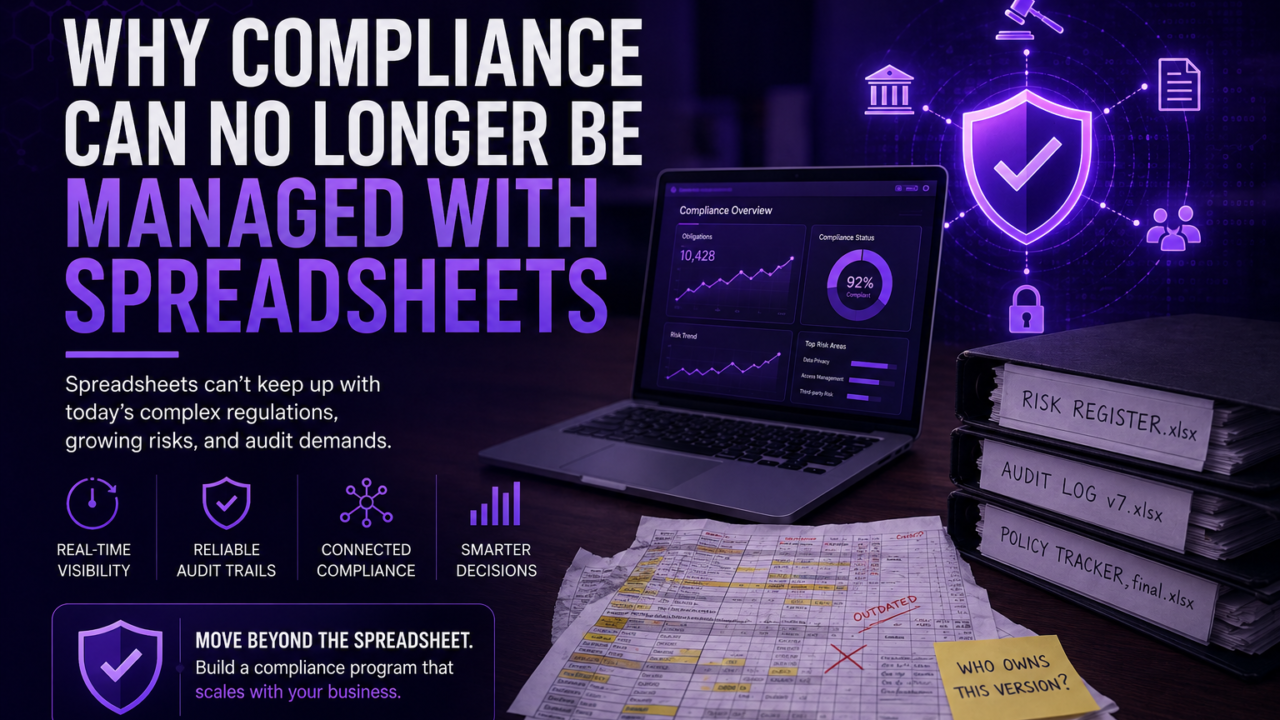
For twenty years, the compliance spreadsheet has been the quiet workhorse of corporate risk management. A grid of cells tracking policies, control owners, audit findings, and deadlines, passed between departments like a relay baton nobody quite trusts. It worked when compliance meant checking a handful of boxes once a year. It does not work anymore, and pretending otherwise is now a liability in its own right.
The Problem Isn’t the Tool. It’s the Shape of the Problem.
Spreadsheets are built for static, bounded data: numbers that sit still long enough to be summed. Modern compliance is neither static nor bounded. A mid-sized company today might answer to overlapping data privacy regimes, sector-specific financial rules, ESG disclosure requirements, and cybersecurity frameworks, each updated on its own schedule, each with its own definition of a violation. A spreadsheet has no way to model a rule that changes mid-quarter, no way to flag that a control satisfying one regulator quietly fails another, and no way to show, in real time, which of a thousand obligations just became noncompliant because a vendor changed its data-hosting location.
Version Control Is Not Governance
Ask any compliance officer where “the real version” of their risk register lives and watch the hesitation. Is it the copy on the shared drive, the one emailed last Tuesday, or the one a departing employee kept locally and never synced back? Spreadsheets have no native concept of authoritative state. Every duplication is a fork, and every fork is a place where the truth can quietly diverge from the record. When regulators ask for evidence of a control’s operation over the past year, the honest answer is often assembled after the fact, not retrieved, which is itself a finding waiting to happen.
The Audit Trail Problem
Compliance is fundamentally an exercise in proving a negative: demonstrating that something didn’t happen, wasn’t overlooked, wasn’t ignored. That requires a defensible, timestamped record of who did what, when, and why. Spreadsheets can log a cell edit, if formatted carefully and never overwritten, but they cannot natively enforce approval workflows, segregate duties, or prevent a well-meaning employee from “fixing” a formula that was actually a control. The audit trail exists only if someone remembered to build one by hand, and hand-built systems fail exactly when volume rises — which is precisely when compliance failures become expensive.
Scale Breaks the Model, Not Just the Nerves
A hundred obligations across three jurisdictions is manageable in a spreadsheet, with effort. Ten thousand obligations across forty jurisdictions, updated by multiple teams, cross-referenced against a live vendor list and an evolving product catalog, is not a spreadsheet problem — it is a systems problem wearing a spreadsheet’s clothes. The tool doesn’t scale linearly with the risk; it scales linearly with headcount, and headcount is the most expensive way imaginable to solve a data-architecture issue.
What Replaces It
The alternative isn’t a fancier spreadsheet template. It’s purpose-built governance, risk, and compliance (GRC) infrastructure: systems that treat obligations as structured, relational data; that connect controls to regulations to owners in a way queries can traverse; that timestamp every change automatically; and that can surface a gap the moment it appears rather than the moment someone happens to look. This costs more up front than a spreadsheet and asks more of an organization’s discipline. It also happens to be the only approach that scales with the regulatory environment companies actually operate in now, rather than the one that existed when the first compliance spreadsheet was built.
How PurpleWASP Stands Out As the Go-To Solution
At PurpleWASP, we built our platform because we watched too many compliance teams drown in exactly the mess this article describes, a risk register in one file, an audit log in another, a policy tracker owned by someone who left the company eighteen months ago. So instead of giving you another module to bolt onto that chaos, we brought policy management, risk management, asset management, incident management, and reporting together into a single connected workspace. One place, one source of truth, no more hunting for “the real version.”
We’re especially proud of how we handle asset visibility. Rather than a list that goes stale the day it’s exported, we built a living inventory of your systems, software, data stores, ownership, and dependencies so your compliance picture updates as your business actually changes, not on the cadence of whenever someone remembers to check. Combine that with policy workflows that formally track every creation, review, approval, and attestation, and you get something spreadsheets simply can’t offer: an audit trail that’s built into the structure of the platform, not reconstructed by hand the night before an audit.
We’ve also put PurpAI, our built-in AI assistant, to work on the parts of the job nobody enjoys, summarising policies, generating assessment questions, surfacing what needs your attention. And our reporting layer turns all of that underlying data into dashboards your board will actually want to look at, instead of a deck someone stayed up assembling from a dozen tabs.
We think this is what “replacing the spreadsheet” should actually look like: obligations as structured data, ownership as something the system enforces rather than something you hope people remember, and visibility that doesn’t depend on opening the right file at the right time. If that sounds like where your compliance program needs to go, we’d love to show you PurpleWASP in action.
The spreadsheet isn’t a moral failure. It’s a tool reaching the honest end of its usefulness. The organizations that recognize this early will spend less time explaining gaps to regulators, and more time closing them before anyone has to ask.