Ask most security teams to describe their top risk, and you’ll hear something like:
“Ransomware is a major risk to our organisation.”
It’s true. It’s also almost useless. That statement doesn’t say which systems are exposed, how an attacker would actually get in, what would happen next, or what it would cost the business. It can’t be measured, prioritised against other risks, or used to decide where to spend the next security budget. It’s a category of concern, not a risk.
A cyber risk scenario is what turns that vague concern into something an organisation can actually assess, compare and act on.
What Is a Cyber Risk Scenario?
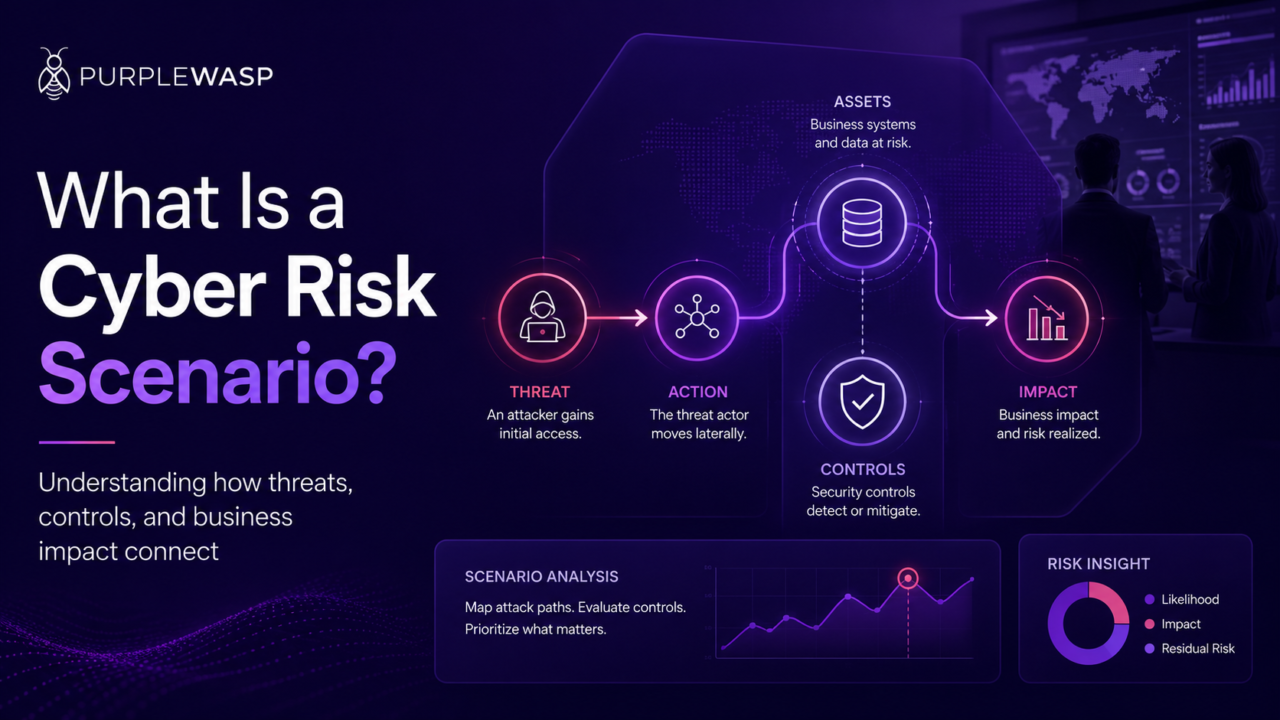
A cyber risk scenario is a structured description of how a threat could affect an organisation, and what that would cost if it happened.
It typically identifies:
- The business asset or process at risk
- The threat actor or event that could cause harm
- How the incident could realistically occur
- The controls already in place that would prevent, detect or limit it
- The operational, financial, regulatory or reputational consequences
A useful scenario is specific enough to support real analysis, without pretending to predict the future in exact detail. It’s a credible model, not a forecast. The goal is to help the organisation explore what could happen, how likely it is, and how severe the consequences would be.
A Risk Scenario Is Not a Threat
It’s easy to confuse a threat with a risk. They answer different questions.
A threat describes something that could cause harm: ransomware, a malicious insider, a misconfigured cloud bucket, a compromised supplier.
A risk describes what happens when a threat interacts with a specific vulnerability, asset and business context, and what that costs if it occurs.
“Ransomware” is a threat. “A ransomware operator encrypting our claims-processing system for four days” is the beginning of a risk.
An Example
A broad risk statement might say:
There is a risk of unauthorised access to customer data.
Accurate, but not useful. It doesn’t explain how access could occur, which controls are relevant, or how the business would actually be affected.
A proper scenario looks more like this:
A ransomware operator gains access through a compromised VPN credential, encrypts the claims-processing environment, and disables accessible backups, causing a multi-day outage to a service that generates €80,000 per day in revenue.
That single sentence gives you something a category label never could: something you can test controls against, estimate a cost for, and prioritise against every other risk on the register.
The Core Components of a Scenario
Most well-written scenarios contain five elements.
1. The business asset or process
Start with something the organisation actually values: customer data, a payment system, a manufacturing line, a critical supplier relationship, a public-facing application. Starting here keeps the scenario tied to why it matters, rather than drifting into a purely technical description.
2. The threat
Who or what is causing the harm. A financially motivated criminal group, a careless employee, a compromised third party, a software supply-chain attack, a system failure. The level of detail should match the purpose of the assessment: some organisations need to separate targeted attackers from opportunistic ones, others don’t.
3. The attack or failure path
The sequence of events that gets from the threat to the asset. For example: an employee receives a phishing email, enters credentials on a fake login page, the attacker uses those credentials to reach a cloud application, weak access restrictions let them reach sensitive data, and the data is exported before anyone notices.
Mapping this path is what lets a security team see exactly where a control should have interrupted the chain.
4. Existing controls
What’s already meant to prevent, detect, respond to or recover from each stage: MFA, monitoring, segmentation, backup and recovery, incident response. A control’s presence doesn’t mean the scenario is handled. It has to be properly designed, fully implemented and actually operating for that to be true.
5. Business impact
What the organisation stands to lose: revenue, downtime, investigation and recovery costs, regulatory penalties, contractual liability, customer trust. Risk becomes far easier to prioritise once it’s expressed in these terms rather than technical severity alone.
Why Vague Risk Statements Cause Real Problems
When risk statements stay generic, three things tend to go wrong.
Everything looks equally urgent. Without specifics, “ransomware,” “insider threat” and “third-party breach” all sit at the same vague level of concern, so leadership has no real basis for deciding what to address first.
Controls get judged in isolation. You can’t meaningfully ask “does our backup strategy work?” without asking against what. A backup process might handle accidental deletion well and fail completely against a ransomware operator who can reach the backup repository using the same credentials as production. The scenario is what tells you which question you’re actually answering.
Conversations stall at the threat level. Boards make decisions based on business consequences, not threat categories. A scenario is what connects a technical concern to a financial or operational one.
Scenarios Should Be Specific, Not Exhaustive
A common mistake is trying to capture every variation of a threat in one scenario. That produces something too broad to be useful, or too long to be read.
It’s better to write several narrow scenarios than one sweeping one. Instead of:
Third-party risk could affect our systems.
Write separate scenarios for the ways that actually matter:
A third-party IT support provider with standing administrative access to our environment is compromised, and the attacker uses that access to move laterally into production systems.
A SaaS supplier that stores customer data suffers a breach, exposing personal data the organisation is contractually and regulatorily responsible for.
These are different risks, with different likelihoods, different consequences, and different controls that would reduce them. Merging them into one vague statement hides all of that.
Scenario vs Threat Scenario vs Risk Statement
The terms get used loosely, so it’s worth separating them.
A threat scenario focuses on the attacker’s actions: “An attacker exploits an unpatched internet-facing application.”
A cyber risk scenario goes further, connecting that event to the asset, the controls, and the consequence: “An attacker exploits an unpatched internet-facing application, gains access to an internal environment, disrupts a critical customer service, and causes several days of downtime and lost revenue.”
A risk statement (“There is a risk that [threat] exploits [vulnerability], resulting in [impact]”) is a useful shorthand for a risk register, but it’s usually still too broad for real analysis. A scenario expands that shorthand into a credible sequence of events with enough context to assess likelihood, control effectiveness and cost.
How to Develop a Cyber Risk Scenario
- Identify the business objective. What is the organisation actually trying to protect: service availability, regulated data, customer trust, an operational process?
- Select a critical asset or process. Start from business exposure, not a vulnerability scan output.
- Identify credible threats. Use threat intelligence, but also internal incidents, near misses, and industry patterns, not just headline attacks.
- Describe the event sequence. Map the realistic steps from the initial event to the business consequence. It doesn’t need every technical detail an attacker might use.
- Map existing controls. For each stage, note what’s meant to prevent, detect, respond to or recover from it, and whether it’s actually designed, implemented, and operating well.
- Assess likelihood. Consider threat activity, exposure, ease of exploitation, historical incidents, and current control effectiveness.
- Assess impact. Break out financial loss, recovery cost, regulatory exposure, and reputational effect separately where possible. Ranges are usually more honest than a single number.
- Decide how to treat the risk. Reduce it, avoid it, transfer it, accept it, or monitor it, with a named owner and target date.
Using Scenarios to Find Control Gaps
One of the most useful applications of a scenario is control-gap analysis. Mapping controls across the full event sequence often shows where the scenario depends too heavily on a single safeguard.
An organisation might have strong controls to stop phishing emails from arriving, but limited ability to detect unusual activity once an account is actually compromised. Working through the scenario can surface that MFA isn’t consistently applied, privileged access isn’t sufficiently restricted, logging doesn’t cover the right systems, or alerts are generated but never investigated in time.
That’s a far stronger basis for a security investment decision than a generic recommendation to “improve controls.”
Common Mistakes to Avoid
Making it too broad. “A cyberattack disrupts the business” can’t be assessed because it names no process, no path, and no consequence.
Making it too technical. A detailed walk-through of exploitation techniques might suit a technical audience, but it buries the business risk. Include only the technical detail needed to explain how the loss happens.
Ignoring existing controls. Skipping this step overstates exposure. Assuming a control works just because it exists understates it.
Treating likelihood as certainty. A scenario models a possible event. It supports a decision made under uncertainty, not a prediction.
Focusing only on prevention. A mature scenario also considers detection, response, recovery, and resilience.
Reusing generic scenarios without adapting them. Industry examples are a fine starting point, but they need to reflect the organisation’s actual systems, dependencies, and risk appetite.
How Many Scenarios Does an Organisation Need?
There’s no fixed number, and the goal isn’t to document every conceivable event. A large scenario library that nobody maintains is worse than a small one that actually gets used.
Most organisations do well with a manageable set covering their most important services and dependencies: ransomware, business email compromise, cloud account takeover, sensitive data exposure, insider misuse, third-party compromise, critical service disruption, and failed recovery. Scenarios should be revisited when systems change, suppliers change, an incident occurs, or the threat landscape shifts meaningfully.
Frequently Asked Questions
What is a cyber risk scenario in simple terms? A description of how a cyber event could happen and what it would mean for the organisation. It connects a threat, an asset, a sequence of events, existing controls, and the resulting business impact.
Is a cyber risk scenario the same as a vulnerability? No. A vulnerability is a weakness that could be exploited. A scenario explains how a threat might exploit one or more weaknesses and what that produces in business terms.
Who should write cyber risk scenarios? Ideally a mix of people: security teams contribute technical and threat context, while business, legal, finance, and operations stakeholders help define the consequences and priorities.
How often should scenarios be reviewed? Whenever there’s a material change to technology, suppliers, business processes, controls, or regulatory obligations, and on a regular cycle in between.
Can cyber risk scenarios be quantified? Yes. Organisations can estimate frequency and financial impact using ranges, historical data, expert judgement, and control-performance evidence rather than relying only on qualitative labels.
From Technical Findings to Business Decisions
A vulnerability, control weakness, or alert doesn’t tell you how much risk the organisation actually carries. A scenario supplies the missing context: how a threat could interact with systems, people, and controls to produce a real business consequence.
Getting the scenario right doesn’t require sophisticated tooling. It requires discipline in how the risk is described. Everything that follows it, control assessment, risk quantification, exception management, board reporting, is only as good as the scenario underneath it.