A security leader tells the board: “This risk is high.”
The board’s next question should be: high before or after controls?
That question is the entire distinction between inherent risk and residual risk. Conflating the two is one of the most common ways risk reporting goes wrong, and it quietly undermines almost every decision built on top of it, from budget approval to risk acceptance sign-off.
What Is Inherent Risk?
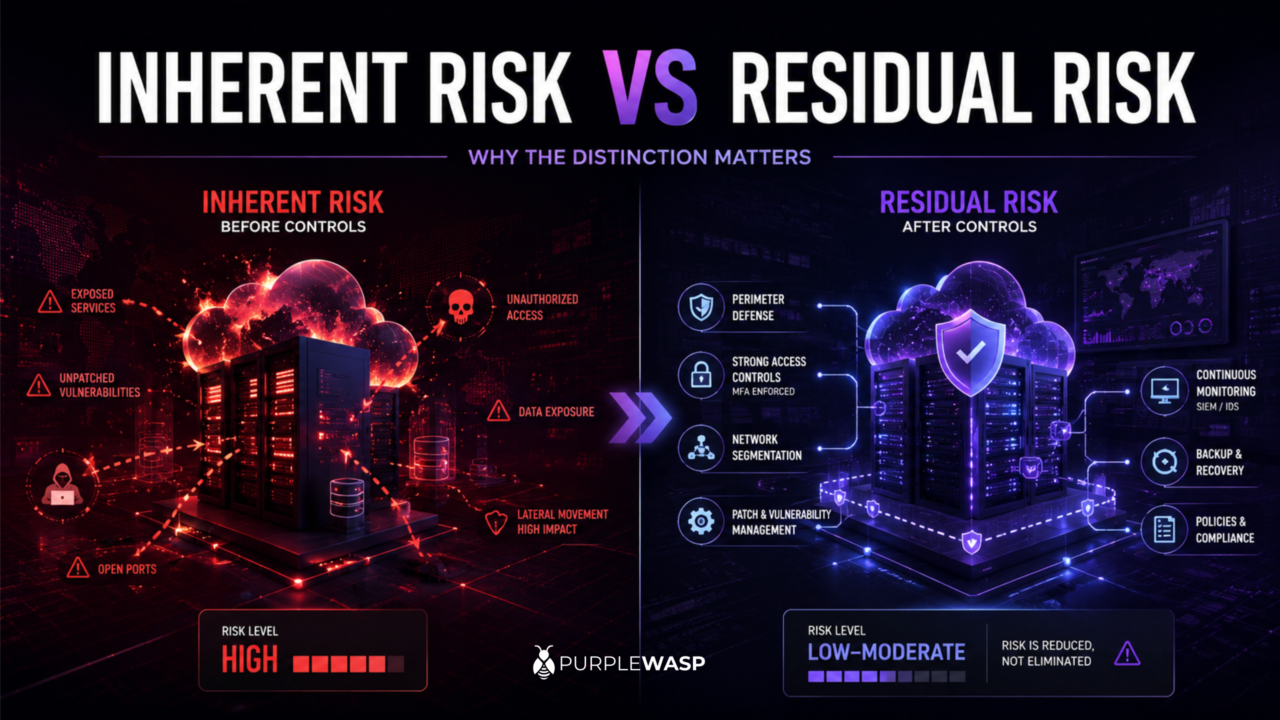
Inherent risk is the level of risk that exists before any controls are applied. It’s the exposure created purely by the nature of the asset, activity, or threat, stripped of anything the organisation currently does to manage it.
If an organisation stored customer payment data with no encryption, no access restrictions, no monitoring, and no firewall, the inherent risk of a breach would be extremely high. That’s not a description of the organisation’s actual security posture. It’s a description of the exposure the situation would create with nothing standing in the way.
Inherent risk is normally assessed by considering two factors: the likelihood that a threat event occurs, and the potential impact if it does. It answers a specific question: how exposed would we be if we did nothing?
What Is Residual Risk?
Residual risk is what remains after controls have been applied. It reflects the organisation’s actual, current exposure, accounting for encryption, access controls, monitoring, and everything else already in place.
Using the same example, once that server has encryption at rest, restricted access, active monitoring, and a properly configured firewall, the residual risk of a breach is meaningfully lower than the inherent risk, even though the underlying activity, storing sensitive payment data, hasn’t changed at all.
Residual risk answers a different question: given what we’re already doing, how exposed are we now?
A simple way to hold both ideas at once:
Inherent risk minus the risk reduction provided by controls equals residual risk.
In practice this is rarely a precise subtraction. Cyber risk involves uncertainty, changing threat conditions, control dependencies, and human behaviour. But the model is still useful because it forces three questions apart: how serious is the underlying risk, how much protection do the controls actually provide, and is what’s left acceptable? Without that separation, organisations tend to either overestimate what their controls are doing or underestimate their true exposure.
Why the Distinction Matters
It tells you whether controls are working, not just whether they exist. A large gap between inherent and residual risk suggests controls are meaningfully reducing exposure. A small gap suggests the controls in place aren’t doing much, even if there are a lot of them.
It prevents false confidence. Reporting only residual risk without ever stating the inherent risk can make a genuinely dangerous activity look inherently safe, when it’s actually a high-risk activity that happens to be well managed right now. That distinction matters enormously the moment a control fails, a key person leaves, or a process lapses.
It prevents false alarm. The opposite problem happens too. An activity with high inherent risk but strong, consistently operating controls can get flagged as urgent simply because “high inherent risk” gets reported as if it were the current state.
It supports proportionate investment. Comparing inherent and residual risk across scenarios shows where controls are earning their cost and where they aren’t. A scenario with high inherent risk and high residual risk, despite significant control investment, deserves scrutiny. Something isn’t working as intended.
A Worked Example
Consider a scenario: a ransomware attack disrupts critical business operations.
Inherent likelihood: High. Ransomware is common, opportunistic, and doesn’t require a highly sophisticated attacker to succeed. Inherent impact: Severe. Encrypted systems and no available protections could halt operations entirely. Inherent risk: Critical.
Relevant controls: endpoint detection and response, network segmentation, vulnerability management, restricted administrative access, offline backups, incident response planning, and recovery testing.
Testing shows most endpoints are monitored and backups are protected. But several legacy systems sit outside the endpoint monitoring platform, and recovery exercises haven’t covered every critical service.
Residual likelihood: Medium. The attack surface is smaller and detection is faster, but real gaps remain. Residual impact: High. Recovery for some services hasn’t actually been proven to work. Residual risk: High.
The inherent risk hasn’t moved. Ransomware is exactly as dangerous a scenario today as before those controls existed. What changed is the organisation’s actual current exposure, and that residual figure, not the inherent one, is what should drive the next decision: extend monitoring to the legacy systems, test full-service recovery, or accept the remaining gap for now with a named owner and a review date.
Inherent Risk vs Residual Risk at a Glance
| Inherent Risk | Residual Risk | |
|---|---|---|
| Reflects | Exposure with no controls | Exposure with current controls |
| Answers | How dangerous is this activity by nature? | How exposed are we right now? |
| Used for | Scoping control investment, understanding worst case | Day-to-day prioritisation, risk acceptance, reporting |
| Changes when | The nature of the activity or asset changes | Controls are added, removed, or degrade |
Residual Risk Is Not the Same as Accepted Risk
These two get treated as interchangeable, but they aren’t.
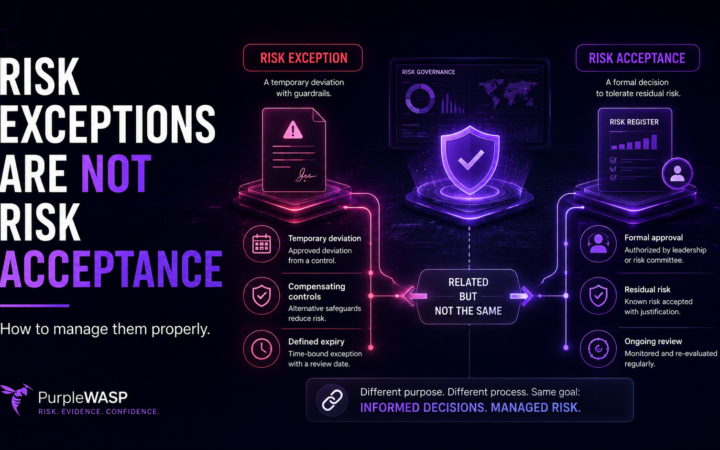
Residual risk is a measurement: the exposure that remains after controls are considered. Accepted risk is a decision: the portion of that exposure the organisation has formally agreed to tolerate.
A residual risk can be accepted, reduced through further controls, transferred through insurance or contractual terms, avoided by stopping the activity, or escalated for further review. What it should never be is silently assumed to be accepted just because no one has raised an objection. Risk acceptance should be explicit, documented, assigned to a named owner, and time-limited where appropriate. Otherwise the organisation is carrying risk that nobody actually agreed to carry.
Assessing Inherent and Residual Risk: A Six-Step Process
1. Define the risk scenario. Name the threat, the target, the event, and the business consequence. “Risk of a cyberattack” is too broad to assess. “A threat actor compromises a privileged cloud account and accesses sensitive customer data, resulting in regulatory investigation and reputational damage” can actually be worked with.
2. Assess inherent likelihood. Consider threat capability and intent, exposure to attack, how easy the scenario is to execute, and how attractive the target is, without factoring in current controls.
3. Assess inherent impact. Consider financial loss, operational disruption, regulatory action, legal liability, and reputational damage if the scenario played out with nothing to stop it.
4. Identify relevant controls. Map only the controls that directly affect this scenario’s likelihood or impact. A long list of loosely related controls doesn’t mean the risk is well managed.
5. Evaluate control effectiveness. This is the step most organisations skip. A control’s existence doesn’t reduce residual risk on its own; it has to be properly designed, fully implemented, applied to the right systems and users, and actually operating. Evidence should come from testing, monitoring data, audit results, or exercises, not from a control owner’s assurance alone.
6. Determine residual risk and compare it to risk appetite. Reassess likelihood and impact in light of the evidence gathered, then weigh the result against how much risk the organisation is actually willing to carry for this kind of activity.
Why Risk Appetite Has to Be Part of the Conversation
A residual risk rating on its own doesn’t tell you whether to act. It has to be read against the organisation’s risk appetite, the amount and type of risk it’s willing to accept in pursuit of its objectives.
A “medium” residual risk might be entirely acceptable for a non-critical internal tool. The same rating on a payment platform or a system holding regulated health data might be well outside tolerance. The right response depends on the importance of the activity, legal and regulatory obligations, customer expectations, the cost of further controls, and what the organisation has actually said it’s willing to carry. This is why a risk rating should inform a decision, not substitute for one.
Common Mistakes
Skipping inherent risk entirely. Many risk registers record only residual risk, since that’s what feels operationally relevant. This hides whether “low residual risk” means the activity is genuinely low risk, or means it’s a dangerous activity that happens to be well controlled right now. Those need very different levels of ongoing attention, particularly if any of those controls degrade.
Treating inherent risk as the number that matters day to day. The opposite error also happens, especially after a thorough initial assessment: teams keep reporting inherent figures in ongoing dashboards, which makes everything look permanently urgent since it ignores the controls actually in place. Day-to-day prioritisation and risk acceptance should be driven by residual risk.
Lowering the score just because a control exists. A control listed on paper isn’t the same as a control proven to work. Multifactor authentication that doesn’t cover privileged accounts or legacy systems shouldn’t earn the same risk reduction as MFA that covers everything.
Assuming controls remove risk entirely. Even well-designed controls can be bypassed, misconfigured, or overtaken by new techniques. Residual risk is very rarely zero.
Failing to reassess. Residual risk shifts as the business changes: new systems, new suppliers, staff turnover, evolving threats. An assessment that’s a year out of date may no longer describe reality.
Turning the Assessment Into Action
The value of comparing inherent and residual risk isn’t the rating itself. It’s what the organisation does with it: which controls need improving, who owns the action, when it needs to be done by, what evidence will show progress, who has the authority to accept whatever risk remains, and when it gets reassessed. Without those outcomes attached, the exercise becomes a documentation task rather than a tool that actually changes the organisation’s exposure.
Frequently Asked Questions
Can residual risk ever be higher than inherent risk? In a correctly built model, no. Controls should reduce exposure, not increase it. If residual risk comes out higher than inherent risk, that usually points to an error in one of the two assessments, or a control that’s actively counterproductive.
Is residual risk the same as acceptable risk? No. Residual risk is a measurement of current exposure. Acceptable risk is a decision about whether that exposure sits within the organisation’s tolerance. A high residual risk can still be formally accepted if the cost of reducing it further outweighs the benefit; a low residual risk still needs periodic review to confirm it stays that way.
How often should inherent and residual risk be reassessed? Inherent risk changes rarely, usually only when the nature of the asset or activity itself changes. Residual risk should be reviewed more often, since it depends on controls that can degrade, get bypassed, or fall out of scope as the environment evolves.
Does every risk need both figures documented? Not necessarily for very low-priority items, but for anything material to the business, recording both gives far more useful information than residual risk alone, particularly for tracking whether control effectiveness is improving or slipping over time.
The Bottom Line
Inherent risk shows what an activity is capable of on its worst day, with nothing standing in the way. Residual risk shows where the organisation actually stands today. Reporting either one without the other leaves out half the picture: without inherent risk, there’s no way to tell whether the controls in place are doing meaningful work; without residual risk, there’s no sound basis for deciding what to accept, invest in, or escalate right now.