Most risk registers exist to satisfy an audit, not to inform a decision. They’re long, they’re rarely opened between review cycles, and when they finally do reach a leadership meeting, half the room spends more time trying to interpret the spreadsheet than discussing what to actually do about it.
That’s not a tooling problem. It’s a design problem. A risk register built around compliance checkboxes will always struggle to support real decisions, because it was never structured to answer the questions leaders actually ask: what could go wrong, how bad would it be, what are we doing about it, and is that enough.
Here’s how to build one that leaders will actually use, rather than one that just gets filed away.
Start With Scenarios, Not Technical Findings
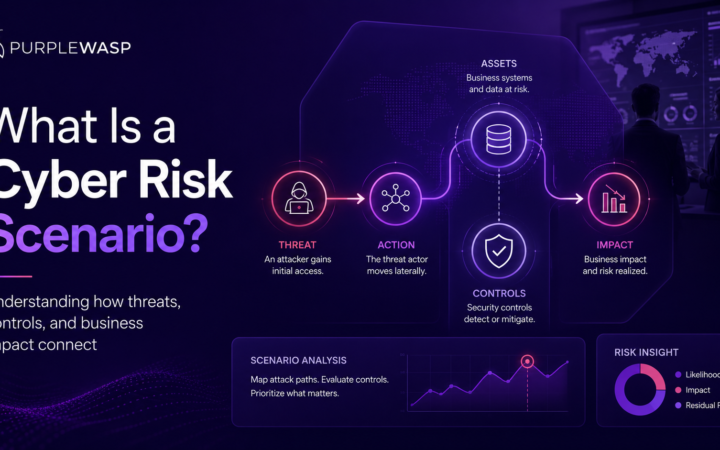
The single most common failure in a risk register is treating every technical issue as its own risk. An unpatched server is a vulnerability. Weak access controls are a control gap. Neither is a complete risk statement on its own.
A risk describes what could happen and why it matters: “A threat actor exploits an unpatched internet-facing application, gains access to customer data, and causes regulatory, financial, and reputational harm” is far more useful than “critical vulnerability on web server.” The technical finding still matters, it just supports the scenario rather than replacing it.
A practical, consistent structure helps entries stay comparable: there is a risk that [threat or event] affects [asset or business service] because of [control weakness], resulting in [business impact]. For example: “There is a risk that compromised privileged credentials allow an attacker to disrupt the payment platform because administrative access isn’t consistently protected by multi-factor authentication, resulting in service interruption, lost revenue, and customer harm.”
Avoid vague entries like “cyberattack,” “data breach,” “third-party risk,” or “ransomware.” These are topics, not risks that can actually be assessed or prioritised against each other.
Link Every Risk to a Business Service
Leaders don’t manage individual servers or security tools. They manage business services, customers, revenue, and regulatory commitments. Every significant risk should connect to the specific business activity it could affect, customer onboarding, payment processing, regulatory reporting, whatever’s relevant, named directly rather than described in general technical terms.
This connection does two things. It helps leaders understand why a risk actually matters to them, and it reveals concentration: several technical risks might affect the same critical service, while one control improvement might reduce exposure across several of them at once. A register that only lists assets can’t show either of those things.
Get Ownership Right, Not Just Named
The person who discovers or manages a technical issue isn’t automatically the person who owns the risk. A security team may identify the exposure. An IT team may operate the affected system. The risk owner should be whoever’s actually accountable for the business consequences if the scenario occurs, and who has the authority to approve treatment, allocate resources, escalate delays, and accept residual risk.
Collapsing everything into a single “owner” field creates real confusion, so it’s worth separating the roles explicitly:
Risk owner, accountable for the exposure and the treatment decision. Control owner, accountable for operating a specific control. Action owner, responsible for completing a treatment task. Asset owner, accountable for the affected system or information.
A risk owner without real authority is just a named contact. Getting this distinction right is what determines whether the person actually facing the consequences is the one making the call.
Separate Inherent Risk From Residual Risk
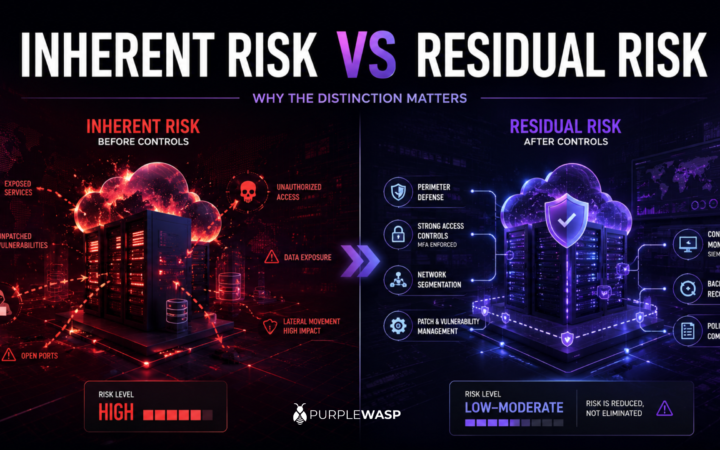
Recording only residual risk hides important context. A risk showing as “low” might genuinely be low-consequence, or it might be a dangerous scenario that’s currently well-controlled and would spike immediately if one of those controls failed. Recording both figures preserves that distinction and makes control drift visible over time: if residual risk creeps upward while inherent risk stays constant, that’s an early signal something in the control environment is degrading.
Residual risk should never drop simply because a control is documented. It should reflect whether that control is appropriately designed, implemented across its full scope, operating consistently, tested recently, and supported by real evidence, not whether it exists on paper. A backup policy doesn’t prove recoverability. An MFA rollout doesn’t prove every privileged pathway is covered.
Don’t Let a Single Score Carry the Whole Assessment
A five-by-five likelihood and impact score is a convenient summary, but it shouldn’t be the whole story. Two risks can land on the same score with completely different characteristics, one occurring frequently with limited losses, the other rare but capable of a catastrophic outcome. They shouldn’t automatically get the same treatment just because they share a colour.
Where possible, add context: expected frequency, an estimated financial loss range, potential downtime, records affected, regulatory or contractual consequence, and how much confidence sits behind the assessment. Not every organisation needs a full quantitative model, but even rough ranges beat unsupported labels like “major” or “likely.” The goal isn’t false precision, it’s making the underlying assumptions visible enough to actually challenge.
Record the Evidence Behind Every Rating
A rating shouldn’t appear without a trail back to how it was reached: vulnerability assessments, incident history, control test results, audit findings, penetration tests, recovery tests, whatever actually supports it. This turns the review conversation from “does this feel red” into “does the evidence support this likelihood, impact, and control-effectiveness assumption,” which is a far more useful conversation to have in a leadership meeting.
Where evidence is genuinely thin, say so. Low confidence isn’t a reason to ignore a risk, it’s a reason to go find out more.
Make the Treatment Options Visible
A register shouldn’t stop at describing the problem. For each material risk, leadership should be able to see the actual response: mitigate, avoid, transfer, accept, or monitor, along with the required actions, owner, target date, estimated cost, and expected reduction in risk. This lets leaders compare not just the risks against each other, but the value of the responses on offer. A modest control that meaningfully reduces several major risks at once can be worth more than a cheaper action that just moves a score without changing much in practice.
Show the Decision Being Asked For
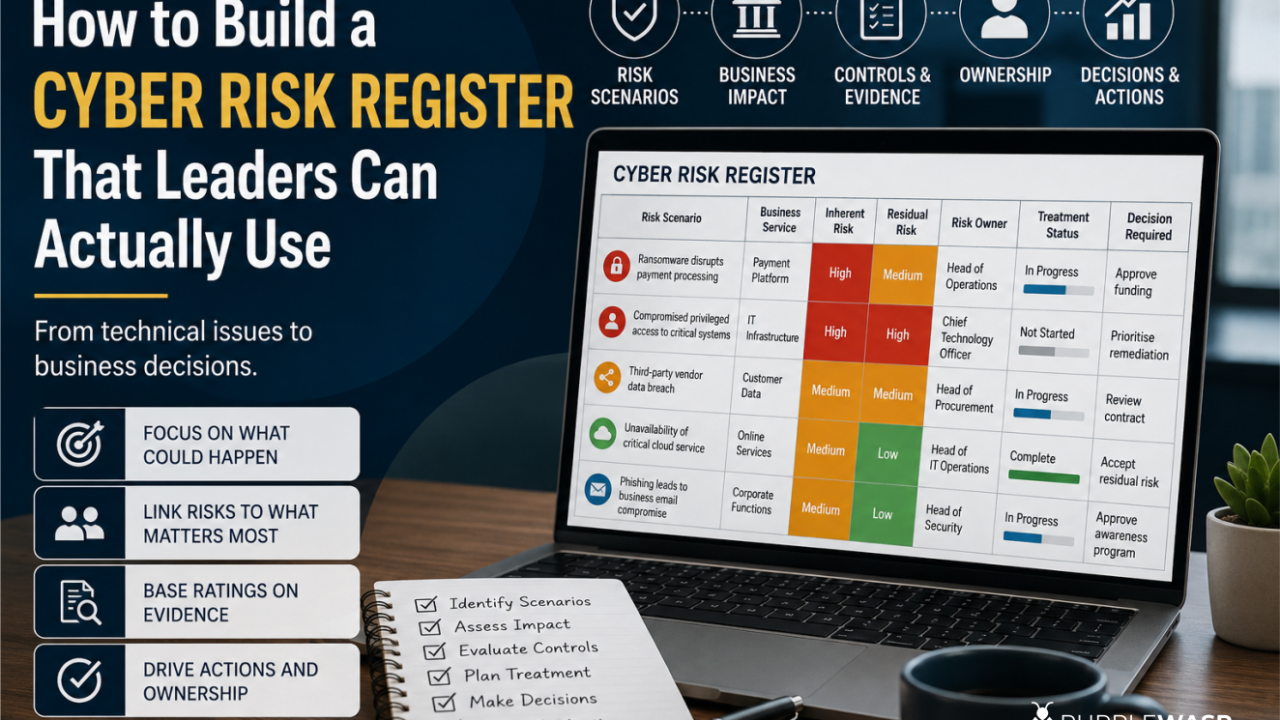
A lot of registers describe problems without ever making clear what leadership is actually being asked to do about them. Every escalated risk should carry a specific decision request: approve funding for a proposed treatment, accept the residual risk until a stated date, prioritise one remediation programme over another, confirm the exposure sits within risk appetite, or assign executive ownership where it’s currently missing.
That single addition is what turns the register from a reporting document into an actual decision tool. Anyone reviewing an entry should be able to see what could happen, why it matters, what’s already being done, and specifically what they’re being asked to decide right now.
Make Risk Acceptance Time-Bound, Not Silent
Accepting a risk shouldn’t mean it disappears from view. Where leadership decides to tolerate a residual exposure, the register should record the exact scenario being accepted, the residual risk level, why further treatment isn’t being pursued, the approving authority, any conditions attached, a review or expiry date, and the specific indicators that would trigger an earlier reassessment.
Risk changes. A new vulnerability, a supplier incident, a business expansion, or a control failure can make a previous acceptance decision invalid overnight. Acceptance needs to be reviewed on a schedule, not quietly forgotten the moment it’s logged.
Track Movement for the Right Reasons
Leaders naturally want to know whether a risk is trending up or down, but that movement needs an explanation attached, not just a new number. A risk shouldn’t shift from high to medium simply because someone nudged a subjective likelihood score. It should move because a control was implemented and actually tested, a critical asset was retired, a supplier failed an assessment, or the business impact estimate genuinely changed.
Without that context attached, movement on the register becomes a reporting exercise rather than real evidence that something changed.
Add Leading Indicators, Not Just Current Ratings
A traditional register looks backward, recording the current rating and past actions. A stronger one also includes indicators that show exposure shifting before an incident forces the issue: percentage of privileged accounts covered by MFA, critical vulnerabilities past their remediation deadline, endpoint monitoring coverage, failed recovery tests, high-risk exceptions nearing expiry, or how long incident containment is actually taking.
These give leadership something to look at between incidents, and they make accountability more concrete, instead of debating a rating in isolation, the conversation becomes about the specific conditions actually driving it.
Keep the Register Focused, Not Just Complete
As a register grows, the same underlying exposure often gets logged multiple times from different angles, one team logs “weak access management,” another logs “privileged account risk,” a third logs a related incident. Left unchecked, this inflates the register and makes real prioritisation harder. Periodically review for overlap and consolidate. It’s also worth challenging entries with no identifiable connection to a real business consequence, these often exist purely because they showed up in a framework or a historical audit finding, not because anyone can explain why they matter now.
A useful structure keeps a smaller set of enterprise-level scenarios at the top, with supporting findings, controls, and treatment actions linked underneath, so detail isn’t lost, it’s just organised for the audience actually looking at it.
Design the Executive View Around Decisions, Not Data
A board or executive risk committee doesn’t need every field from the underlying register. The leadership view should show the scenario, the affected business service, the accountable owner, current and target exposure, key control weaknesses, treatment status, what’s changed, the decision required, and how the exposure sits relative to risk appetite. It should also flag overdue treatment actions, risks that have been accepted repeatedly without progress, and concentrations across suppliers, assets, or technologies.
The goal isn’t to make the register look impressive. It’s to help leaders ask better questions and actually make decisions with it.
Signs Your Register Isn’t Working
A few reliable warning signs: most entries are technical findings rather than scenarios, risk owners can’t explain the business impact in their own words, everything is rated high, ratings change with no supporting evidence, accepted risks have no review date, control effectiveness is assumed rather than tested, treatment plans list no cost or expected benefit, the board gets colours but no actual decision requests, and the register only gets updated right before an audit or a meeting.
None of these are formatting problems. They’re governance problems, and they’re usually fixable by applying the structure above rather than by adding more fields.
How PurpleWASP Supports This
A risk register becomes hard to maintain when risks, assets, controls, evidence, and treatment actions live in separate spreadsheets that never quite stay in sync. PurpleWASP keeps risk scenarios linked to the business services they affect, the controls responsible for reducing them, the evidence behind those controls, and the actions in progress, all in one place, so it’s possible to go from a leadership summary straight down to the underlying evidence for any given risk without reconstructing that trail by hand every time someone asks a harder question.
Frequently Asked Questions
How many risks should be on a register? There’s no fixed number, but a register with hundreds of granular, rarely reviewed entries is usually less useful than one with a smaller number of well-defined, actively maintained scenarios covering the organisation’s most important services and dependencies.
Who should own the risk register itself? Security or risk teams typically maintain the register’s structure and process, but individual risk entries should be owned by whoever has the authority to make the relevant treatment decision, which is often a business owner rather than a technical one.
How often should the register be reviewed? High-consequence risks should be reviewed more frequently than low ones, and any risk should be reassessed off-cycle after a relevant incident, a significant system change, or a control failure, rather than waiting for the next scheduled review.
Should the register include both inherent and residual risk? Yes, for anything material. Residual risk alone hides whether a low rating reflects a genuinely low-risk activity or a dangerous one that’s currently well-controlled, a distinction that matters a great deal if a control later fails.
The Bottom Line
A risk register that leaders actually use isn’t the one with the most entries or the most detailed spreadsheet. It’s the one that connects credible scenarios to business services, real ownership, evidence-backed residual risk, and an explicit decision, so leadership can see what could happen, why it matters, what’s being done, and where their authority is actually needed. That’s the difference between a document that gets filed away and one that genuinely shapes where the organisation spends its time and money.